Category Archives: Daily Report

Drug-Induced Liver Injury

Highlighted_Liver_crop

Thank you Dr. Reynolds for an excellent presentation on drug-induced liver injury

Teaching Points

  • Patterns of abnormal LFTS
    • Hepatocellular: high AST/ALT w/mild elevation in alk phos
    • Cholestatic: High alk phos w/ mild AST/ALT
  • Causes of hepatocellular injurry
    • Alcohol: AST elevation greater than ALT
    • Viral: ALT elevation greater than AST
    • NAFLD/NASH: AST to ALT ratio typically 1
    • Toxins: NSAIDS, abx, statins, anti-epileptic drugs
    • Hereditary/autoimmune: hemochromatosis, autoimmune hepatitis, alpha-1-antitrypsin deficiency, Wilson’s disease
    • Shock: high elevations in AST/ALT
    • Non-hepatic causes: muscle disorders, thyroid issues, celiac disease, adrenal insufficiency, anorexia

Continue reading

Atrial Fibrillation

Thank you Dr. Feng for an excellent presentation on the management of atrial fibrillation in the setting of acute de-compensated heart failure

Teaching Points

  • Important components of management: hemodynamic stability, rate control, anti-coagulation
  • Rate control agents: beta blockers, calcium channel blockers (not preferred in HF), digoxin and amiodarone (also an anti-arrhythmic)
  • Antiarrhythmics for afib are Class IC or III
    • IC: flecainide, propafeonone
    • III: amiodarone, dronedarone, sotalol, dofetilide
  • Anti-coagulation: indicated if CHADSVASc ≥ 2 (warfarin or newer agents, ie apixaban or rivaroxaban)

Continue reading

Granulomatosis with Polyangiitis Glomerulonephritis

Thank you Dr. Jang for an excellent presentation on granulomatosis with polyangiitis presenting as lower extremity edema from renal involvement.

Teaching Points:

  • GPA can involve multiple organs including nasal ulcers, cartiglage destruction, tracheal stenosis, alveolar hemorrhage, glomerulonephritis, leukoclastic angiitis
  • Diagnosis is made by biopsy and positive ANCA
  • Treatment involves 2 components: induction of remission and maintenance to prevent relapse.  Induction is with steroids and rituximab or cyclophosphamide.  Maintenance regimens include methoetrexate, azathioprine, rituximab, and tapering of glucocortidoids.

Further Reading:
Ritximab vs Cyclophosphamide for ANCA – Associated Vasculitis (RAVE trial)
Rituximab vs Azathioprine for Maintenance in ANCA-Associated Vasculitis (MAINRITSAN trial)
Azathioprine or Methotrexate Maintenance for ANCA-Associated Vasculitis (WEGENT trial)


Ischemic Stroke From Infective Endocarditis

stroke

Thank you Dr. Tu for an excellent presentation of ischemic stroke due to septic emboli from infective endocarditis

Teaching Points:

  • CNS complications of infective endocarditis can occur in 20-40% patients
  • Etiology: occlusion of cerebral arteries by septic emboli, cerebral hemorrhage, meningitis, encephalitis, brain abscess, mycotic aneurysm
  • Diagnosis using Duke Endocarditis Diagnostic Criteria
  • Treatment tailored antibiotics for 4-6 weeks

Further Reading:
Management of neurological complications of infective endocarditis in ICU patients

Evidence Based Medicine:
Analysis of the Impact of Early Surgery on In-hospital Mortality of Native Valve Endocarditis

Progression of Myocardial Infarction

MIThank you Dr. Janoian for a great presentation on the progression of myocardial infarction.
Teaching Points:

  • pathologic outcomes of MI: arrhythmia, ischemic cardiomyopathy with or without cardiogenic shock, mechanical dysfunction/complications, pericarditis
  • mechanical complications: papillary muscle rupture, ventricular free wall rupture, ventricular aneurysm

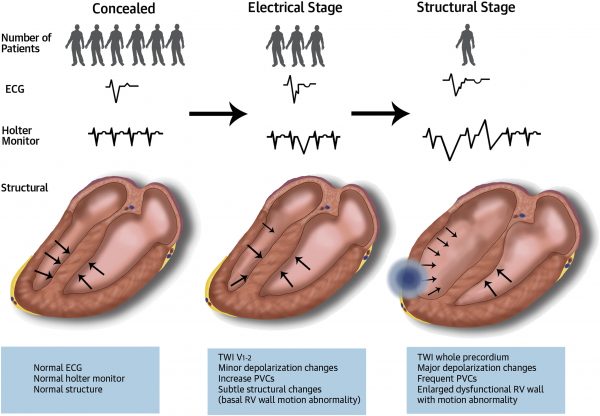
Arrhythmogenic Right Ventricular Cardiomyopathy/Dysplasia

ARVD

Thank you Dr. Layoun for an excellent presentation on arrhythmogenic right ventricular cardiomyopathy/dysplasia

Teaching Points:

  • ARVD is a genetic cardiomyopathy with mutations in desmoglein-2, desmoplakin, desmocollin-2, plakophilin, etc
  • Characterized by life-threatening ventricular arrhythmias (monomorphic VT)
  • ECG: QRS prolongation (in right precordial leads), RBBB morphology, Epsilon Wave (distinct wave between QRS and T waves, seen in precordial leads, V1 is the best spot)
  • Treatment: refrain from high intensity exercise, low dose beta-blocker, ICD for secondary prophylaxis in patients with history of VT or VF

Continue reading

Septic Arthritis

Thank you Dr. John Hollowed for a great presentation of a pain with acute onset R. shoulder and L. knee pain/swelling s/p arthrocentesis c/w infectious process (gram stain with GPC’s, WBC >200K). Patient also likely with native valve endocarditis

Teaching Points: 

–Septic arthritis an orthopedic emergency! Consult ortho as patient may require surgical irrigation and debridement

–Oligoarticular or polyarticular infection occurs in approximately 20 percent of septic joint infections, usually involving two or three joints.

Continue reading

Diabetic Myonecrosis

diabetic myonecrosis

Thank you Dr. Jane Ma for a a great presentation of a woman with right thigh pain and swelling, found to have diabetic myonecrosis

Teaching Points: 

  • Rare complication associated with poorly-controlled DM caused by infarcted muscle tissue
  • Acute pain and swelling of the affected muscle, most often in the lower extremities (most commonly in the thigh, second most common is calf pain/swelling)
  • Usually no history of trauma or fever
  • Usually in patients with poor glycemic control and complications of that (nephropathy, retinopathy, neuropathy)
  • MRI: imaging study of choice
  • Must rule out infectious causes, often with a CT-guided biopsy (ie. pyomyositis)
  • Muscle biopsy: can give you a definitive diagnosis but not currently recommended due to risks of complications from procedure and increase in time to recovery
  • Management: Conservative: Rest, pain control, NSAIDs